Blog
NERIS is here: What it means for fire departments
NERIS is here. Now what?
Ushering in the next era of fire data with ESO
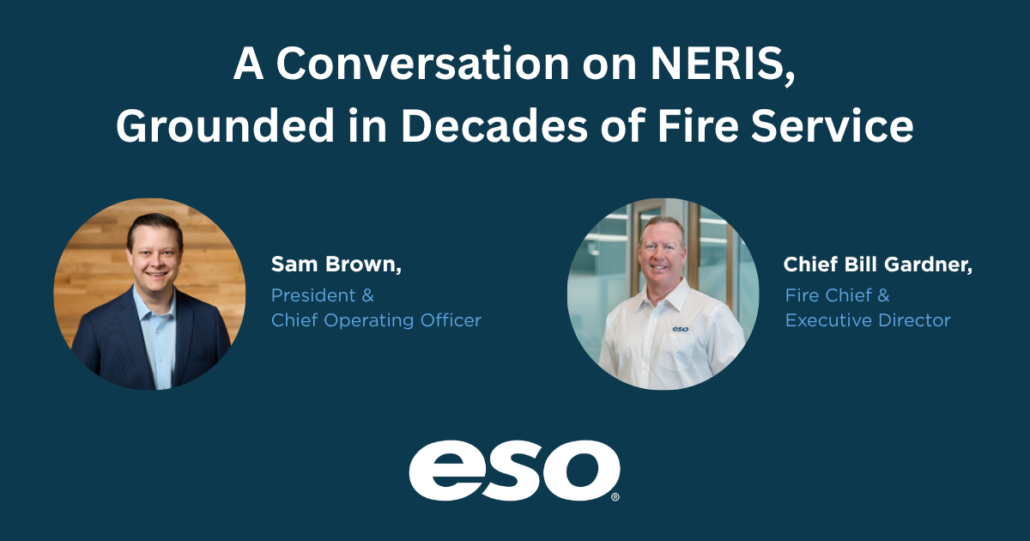
Bill Gardner, executive director of fire and EMS at ESO, sat down with Sam Brown, ESO president and chief operating officer to discuss the one topic that’s forefront on the industry’s collective mind: The move to NERIS.
Both bring a firsthand perspective to the conversation. Gardner served nearly 40 years in the fire service, starting in an all-volunteer rural department, then working in a metro area, and finally retiring as fire chief. Brown, who is currently active in the industry, started in a volunteer rural department and is now an assistant fire chief when not at ESO.
Together, they bring a collective 60 years of experience to this round table discussion, covering where NERIS stands today, how ESO has adapted to support the new system, and what is next for both ESO and the industry.
Here are some key takeaways from their discussion:
Why the shift to NERIS?
For decades, NFIRS served as the industry’s documentation standard, changing little over time as the fire service transformed around it: transitioning from paper reports, trifolds, and signal computers, to flip phones and bag phones, to today’s connected smart devices and the rise of artificial intelligence. As the industry modernized, the legacy system struggled to keep up. Despite tedious documentation, the insights pulled were dated, inconsistent, and not reflective of where the fire service stands today.
NERIS was built to continuously keep up with department needs, with annual updates that allow it to change with the industry, a departure from the limited changes NFIRS allowed over time. The system puts data at the forefront, linking incident data to community risk prevention and allowing the fire service to take charge of its own story for the first time.
What does this mean for departments?
The benefits of NERIS are practical. A few stand out: easier incident reporting gives crews the ability to capture multiple incident types at once. Thanks to better-informed prevention planning, departments can now use data to identify high– and low-frequency calls as well as high-risk ones, so training can be based on insight rather than instinct. Finally, faster overall reporting gives crew more time for the job they trained for instead of compiling reports at their desk.
What changed and what stayed the same?
Like NFIRS, NERIS still requires crews to document every incident and every call, with complete, timely, and consistent data as the goal. Where NERIS diverges is that it’s built more for analysis than to keep tabs on the industry. In the incident types themselves, some low-value data fields have been dropped while new elements were added or reorganized, shifting workflows rather than making it a clean one-for-one swap. The result is a stronger link between incident data and community risk.
What role does ESO play?
Built by first responders trying to solve their own reporting problem in 2004, the ESO mission has always been to improve community health and safety outcomes through the power of data. Aiding departments in their transition to NERIS is a natural next step for the organization. When the new standard was announced, ESO faced a choice. As Gardner put it:
“Do we squeeze NERIS into a technical environment around NFIRS or do we stop, invest, and prepare to really go in and build a system that will have a few hiccups along the way?”
As a partner to an industry built on decades of established process, ESO chose to invest and rebuild rather than retrofit their old platform around the new standard. In doing so, ESO accepted some short-term growing pains, in exchange for a system built to keep pace with NERIS in the long term. The new system also limits change to crews’ actual workflows, preserving familiarity, easing the friction of a large transition, and minimizing the need for retraining and disruption at the field level.
How did the ESO platform change?
“We had to get a system that was acceptable for improving operational data collection without creating a task that was going to be impossible.” Gardner said.
ESO eliminated several low-value data fields that didn’t serve the insights the industry needed. The new platform also better aligns with NERIS to give departments the ability to capture multiple incident types on a single call. They can more easily document the full story of more complex calls, such as a motor vehicle accident with both entrapment and fire. Removing some of these friction points led to faster report completion and getting crews back in service sooner.
But one of the greatest benefits for departments is the capability to understand and share their story like never before. As Gardner put it, “Are we as an agency able to manage and deal with the things we have going on? What are our high frequency calls? But more importantly, what are our low frequency, high risk calls? And what are we doing to improve our training?”
This shift lets the industry focus on the positive for the first time – not just the value lost in fires, but what was actually saved. Having that data also gives organizations the factual evidence needed to build their case to boards, councils, and elected bodies when requesting funds. And with multiple tools for extraction, including ESO Insights, Snowflake, and Query Builder, departments can access data exactly how they need to.
As Brown added, “It’s not measuring things for academic purposes or the nice to knows, but how do we do something with it? What’s the tactical or the strategic activity that we’re going to undertake to solve for whatever it is that that we’re facing as an industry and or as a region?”
Where does NERIS stand today?
Compliance is just the start. Gardner and Brown were candid that a number of updates are still in the works, but a few are far enough along to share:
- Persons, owners, vehicles, and insurance data – is rolling out over the next quarter
- Expanded address search – a searchable pop-out, rather than a filter, that returns date- and shift-filterable results, with print/export support for open-records requests
- Expanded CAD API integration – closing gaps where incident types were not mapping over due to inconsistent CAD vendor connections
- Custom forms – for capturing one-off data needs, rolling out through 2027
- Riding position and crew role designation – tied to scheduling software, expected mid 2027, following schema two and the health and safety fields
- NERIS V2 standard – in discussion for spring or summer 2027, with further changes expected
None of this is finalized on the roadmap. Since NERIS itself is built to change with the industry, the ESO platform is adapting in the same way.
How does AI fit into these plans?
Before speaking to the benefits of artificial intelligence, Brown wanted to ensure listeners that ESO leads with caution before capability when it comes to AI, using it to empower humans, not to take them out of the equation. Whether used for fire, EMS, trauma, or CAD, every AI product is meticulously vetted to ensure that all outcomes always keep human judgement in the loop, especially in the review process.
As Brown puts it, “You can develop software very quickly, but getting software that’s safe and has been developed with an ethical framework is incredibly important.”
As to what’s in the works: free-text query is already live in EMS Quality Management and expanding to Fire and Inspections, allowing departments to ask a plain-language question and get back relevant records. Next up is AI-assisted inspection, using tablets, phones, and body cameras to help inspectors identify and report violations quickly and easily.
Staying ahead of the standard
NERIS represents a shift from a decades-old standard unable to keep up with the demands of today’s fire service to a system built to withstand continuous change. In line with their mission, ESO is here to help departments not just stay compliant with the new standard but to get more value from the data they’re already collecting.
The ESO commitment extends beyond the department level. Twice a year, ESO convenes fire and EMS professionals in Austin to explore what insights can be pulled from the broader dataset. The ESO team is also partnering with ULFSRI and IPSDI, sharing findings to help the future NERIS development, and aligning its data fields to the new cancer registry API so exposure data can be collected consistently without conflicting with NERIS standards.
Listen in to the full round table, including a Q&A that answers some of the community’s most pressing NERIS questions. Let the ESO know what’s getting in the way of your own transition, by reaching out to your team or checking out available training resources.