Blog
The best of Wave 2026: Shifting the emergency response ecosystem from reactive to predictive
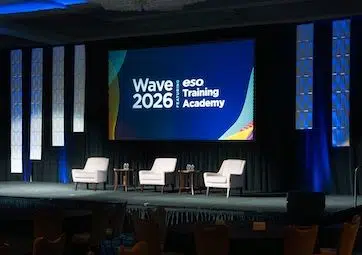
Wave 2026 is over. The conversation is just getting started.
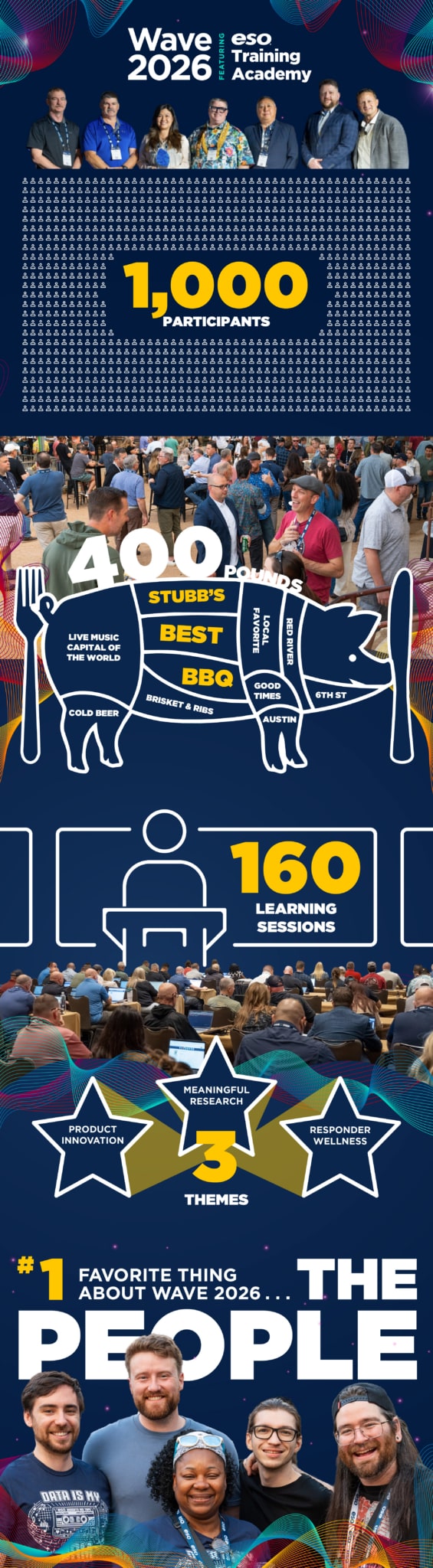
You see the numbers, but they only tell part of the story.
The first week of April, a fresh crew showed up at the JW Marriott Hotel in Austin, Texas, for Wave 2026 featuring ESO Training Academy. This year, the entire emergency response ecosystem came together – EMS, fire, hospitals, and government – to shape the future of health and safety outcomes.
About Wave
Wave 2026 combined the best in thought leadership, data analysis, insights from the field, and networking opportunities. It took the shape of topic-themed breakout sessions, in-depth technical assistance, mainstage expert presentations, and networking.
The 75 unique breakout sessions offered tracks for hospital, fire, and EMS professionals. Topics ranged from improving revenue cycle management with automation and building modern communication centers, to decontaminating equipment after lithium-ion battery fires and reducing unnecessary emergency responses based on evidence. Favorites included:
- AI applications with practical life uses in “Essential AI Apps for Home and Work in 2026”
- All NERIS and fire safety data conversations, led by UL Fire Safety Research Institute
- Eye-catching titles such as “Kevin Costner and the Circle of Death: Technology in Cardiac Arrest,” “Revenge of the Nerds,” and “Drowning in Data but Lacking Information? Here’s Your Lifesaver”
Concurrently, the ESO Training Academy provided 85 in-depth training courses on the ESO Suite. ESO experts led administrators and field providers through examples, templates, and tips. Solutions with the highest interest included Insights for Fire and EMS, training on EHR, and NERIS Admin.
“A few years ago, the idea that you could look at a patient encounter from dispatch to discharge was a pipe dream. But it’s real now!” – Ali Treichel, ESO
Who didn’t attend Wave?
More than 1,000 participants traveled locally and globally to join Wave 2026. Representatives from community hospitals, regional health systems, and large national healthcare systems sat side-by-side with volunteer, part-time, career, and large metropolitan fire and EMS departments.
“We are moving from responding to responsibility. From checking the boxes and moving on to learning from each encounter and improving.” – Brent Myers, MD, MPH, ESO
A unique set of corporate leaders from Amazon (AWS), Motorola, Palo Alto Labs, and Evolv – which are decidedly outside the usual circle – took the stage to emphasize the value of AI in health and its power to change the future.
“For every 10 AI projects, eight will fail. Only two will have an ROI worthy of going into production. But those two can have up to 500% ROI. We need to experiment with AI.” – Jason McNamara, AWS
Building a connected emergency response ecosystem means building relationships with innovative partners, large and small. Speakers from Handtevy, FirstWatch, OneDose, Tablet Command, and Pulsara shared how emerging products and evolving technology can change the speed of insights and decision-making.
“Working together, we’ll move from fragmented to connected, from information to intelligence, and from reactive to proactive and predictive.” – Vindali Vartak, Vice President of Product Management, ESO
Connecting data points
If the insightful content and noteworthy networking weren’t enough, ESO also announced its acquisition of d2i at Wave. A healthcare performance improvement company, d2i transforms siloed electronic medical record, revenue cycle management, scheduling, and patient experience data into operationally actionable insights. Together, ESO and d2i’s combined platform will create connected intelligence across the full emergency lifecycle.
It’s about patients and responders
Despite the numerous times attendees heard the words “research” and “AI” and “data solutions,” the true reasons for Wave lingered near the surface – and close to the heart.
Technology has enormous potential to improve patient outcomes, but as Peter Anvtevy, MD, from Handtevy pointed out, “There’s no app, no tech that keeps your hands from being too sweaty to put on your gloves.” Stress management and interpersonal skills must continue to be trained and used.
Baptist Health South EMS leader Elizabeth Harney, NRP, APP, CCP-C, brought attendees to tears with her poignant story about compassion in action. And a panel of polished speakers each shared the professional moment they realized change needed to happen in the industry – and none of the stories had happy endings.
Deeply personal work
Stefanie Simmons, MD, and Chief Medical Officer for Dr. Lorna Breen Heroes’ Foundation, spoke about emotional challenges that are unique to first responders and hospital employees. She shared statistics on depression, burnout, and suicide, and the stigmas preventing seeking help.
“To fulfill the privilege of caring for people on the worst day of their lives, we must take care of ourselves like athletes. And that includes rest.” – Stefanie Simmons, MD, Dr. Lorna Breen Heroes’ Foundation
Sam Brown, President and Chief Operating Officer of ESO, closed the event by highlighting three themes that emerged. The first two were product innovation and research that matters.
As a data and tech company, ESO’s job is to focus on removing friction in daily work, so firefighters, EMS, hospital registrars, and hospital directors can focus on their jobs. This is why ESO is deeply investing in AI features across the emergency response ecosystem.
The third theme was responder wellness, both physical and mental. Sam lingered on this, mentioning the loss of someone recently. “This work is deeply personal,” he said. It’s also deeply shared.
Time and again, when asked about the best part of Wave, folks didn’t say Stubb’s BBQ, Austin’s bats, or bottomless biscuits. The number one reason attendees return to Wave, bring their colleagues, and stay for days, is the people.
This work is about using data to improve health and safety outcomes – for everyone. And so is Wave.
Save the date for Wave: March 29-April 2, 2027. Be a part of the emergency response ecosystem turning fragmented data into connected intelligence and shifting reactive responses into predictive decisions.